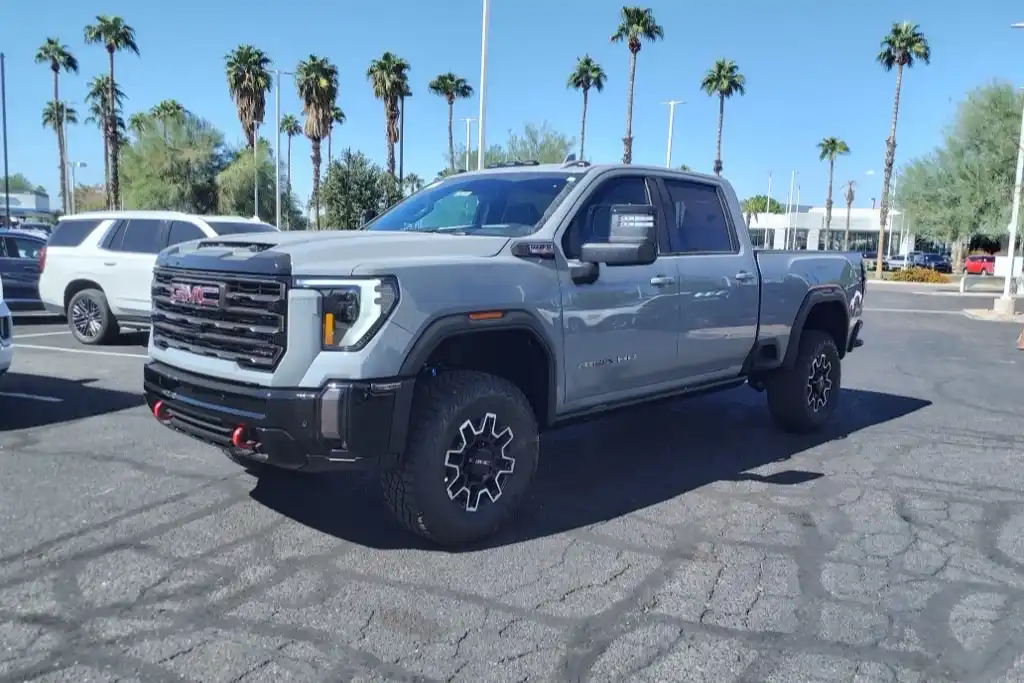
Anthem sits at the top of the Valley, where I-17 stops being a city freeway and starts being a mountain road. That geography decides which diesels live up here. A lot of them are personal trucks, bought to pull something: a fifth wheel to Flagstaff, a toy hauler to Table Mesa, a boat to Lake Pleasant, a horse trailer north on the weekends. Floorjack Auto Repair is fifteen minutes south on I-17, at Happy Valley Road, and the trucks that tow out of Anthem are exactly what we see.
What the climb does to a loaded diesel
Northbound out of Anthem, the freeway climbs through New River and Black Canyon City and does not let up until Sunset Point, about a thousand feet higher than where you got on. Keep going and Flagstaff is another four thousand feet on top of that. Hook twelve thousand pounds to the back of a truck and that climb is the hardest hour that engine will ever work. It is also where hidden problems stop hiding.
Exhaust gas temperature is the first thing to move. A restricted air filter, a boost leak at a clamp or a cracked boot, an intercooler packed with desert grit, or a variable-geometry turbo whose vanes stick will each starve the engine of air, and the engine answers by running hotter. Coolant temperature follows, then transmission temperature, because a torque converter that never locks up on a grade dumps heat straight into the fluid. None of that shows up on a Costco run. All of it shows up on the pull to Sunset Point.
Do that climb in July at a hundred and ten degrees and there is no margin left. Arizona owners learn this the expensive way, usually as a head gasket, a burnt transmission, or a turbo.
Coming back down is its own problem
Loaded descents cook brakes. Riding them down from Sunset Point into the Valley heats pads, rotors, and fluid until the pedal goes long and soft, and if your brake fluid has never been flushed, moisture in it boils and the pedal goes to the floor. That is not a worn-pad problem. That is a fluid problem, and it is cheap to fix before the trip and terrifying to discover during it.
The other half of the answer is the exhaust brake. If your truck has one and it is not holding the way it used to, that is a repairable fault, not a quirk you live with. We check brake condition, fluid condition, and the exhaust brake together, because on a towing truck they are one system.
Towing, RV, and toy hauler setups
The trailer is not our department. Trailers, fifth wheels, boats, and motorhomes bigger than a 3500 chassis are not something we take in, and we would rather tell you that now than after you have driven down. Everything on the truck side is ours:
- Hitches, receivers, and weight distribution hardware.
- Brake controllers and the 7-pin wiring behind most trailer-brake complaints.
- Transmission coolers, fluid service, and the temperature problems that come from towing at factory cooling capacity.
- Radiators, intercoolers, hoses, water pumps, and fans.
- Brakes, wheel bearings, ball joints, and suspension under a loaded tongue weight.
- Tires and alignment, which a truck that tows goes through differently than one that does not.
The trip inspection is the cheap version
Almost every tow-season repair we see could have been a twenty-minute look in the driveway a month earlier. Before a long haul we go over coolant and cooler faces, transmission fluid and flow, the air filter and every boost clamp, brakes at all four corners plus the trailer connection, bearings, and tire age. We also pull codes even when the dash is clean, because a pending emissions fault is what becomes limp mode outside Camp Verde.
Short trips are hard on a diesel particulate filter and long tows are hard on everything else, and an Anthem truck usually does both. If the DPF has never completed a regen cycle properly, towing is when you find out.
Commercial and medium-duty trucks
Not every diesel up here is a weekend truck, and plenty are both. Anthem has contractors and small outfits of its own, and half the time it is one truck doing two jobs: a service body Monday through Friday, a trailer behind it Saturday morning. That truck gets the wear of a work vehicle and the load of a tow rig, and it needs its intervals set against the harder of the two, not the easier one. We take light and medium-duty work up to a 3500 chassis, and we will put a maintenance schedule against it so the truck comes off the road on your calendar instead of on its own.
How our pricing works before you book
Every job starts with a diagnosis and a price you approve, and the price does not move once the truck is apart. If the number lands at the wrong time, financing splits it into payments. Everything we do on a diesel, including injectors, turbos, and cab-off engine work, is on our diesel repair page. When you are ready, call (623) 363-5990 or book online and point the truck south on I-17.